The Rise of Programmable Biology
For most of human history, innovation in biology followed a simple pattern.
Nature invented. Humans discovered.
Penicillin existed long before Alexander Fleming observed it. Insulin regulated blood sugar long before it became a therapy. Every protein, enzyme and biological pathway emerged through processes that unfolded over millions of years, shaped not by intention but by the slow, iterative logic of evolution.
Scientists sought to understand and adapt what nature had already created. Progress came through observation, experimentation and discovery. Even the most transformative breakthroughs revealed what already existed rather than creating something entirely new.
Humanity became remarkably skilled at deciphering nature's language, but the language itself remained nature's alone.
Today, that relationship is beginning to change.
For the first time, biology is moving beyond understanding life toward the possibility of shaping it with increasing intention. The transition remains incomplete, and many of its implications are still unfolding, but its direction is becoming difficult to ignore.
What was once a science devoted almost entirely to discovery is gradually becoming a discipline of design.
Biology's First Revolution Was Learning to Read Life
The first phase of modern biology was not about rewriting life. It was about learning to read it.
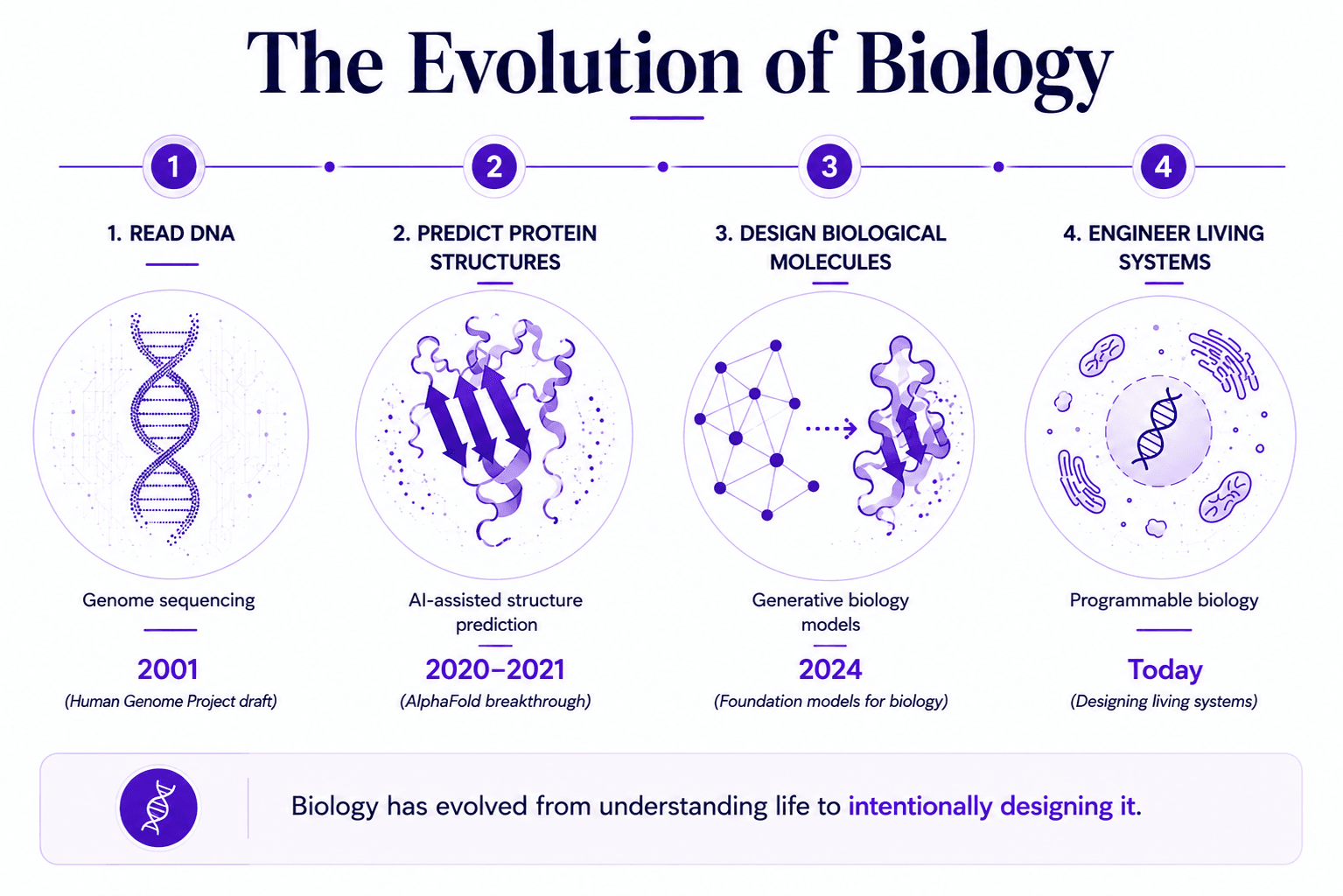
The Human Genome Project was a turning point in that journey. For the first time, humanity possessed a comprehensive map of the genetic instructions that underpin living systems. Over the following two decades, sequencing technologies became dramatically faster and more affordable, reducing the cost of decoding a human genome from nearly $100 million to around $525. Biology was no longer constrained by a lack of data. It was becoming an increasingly digital science.
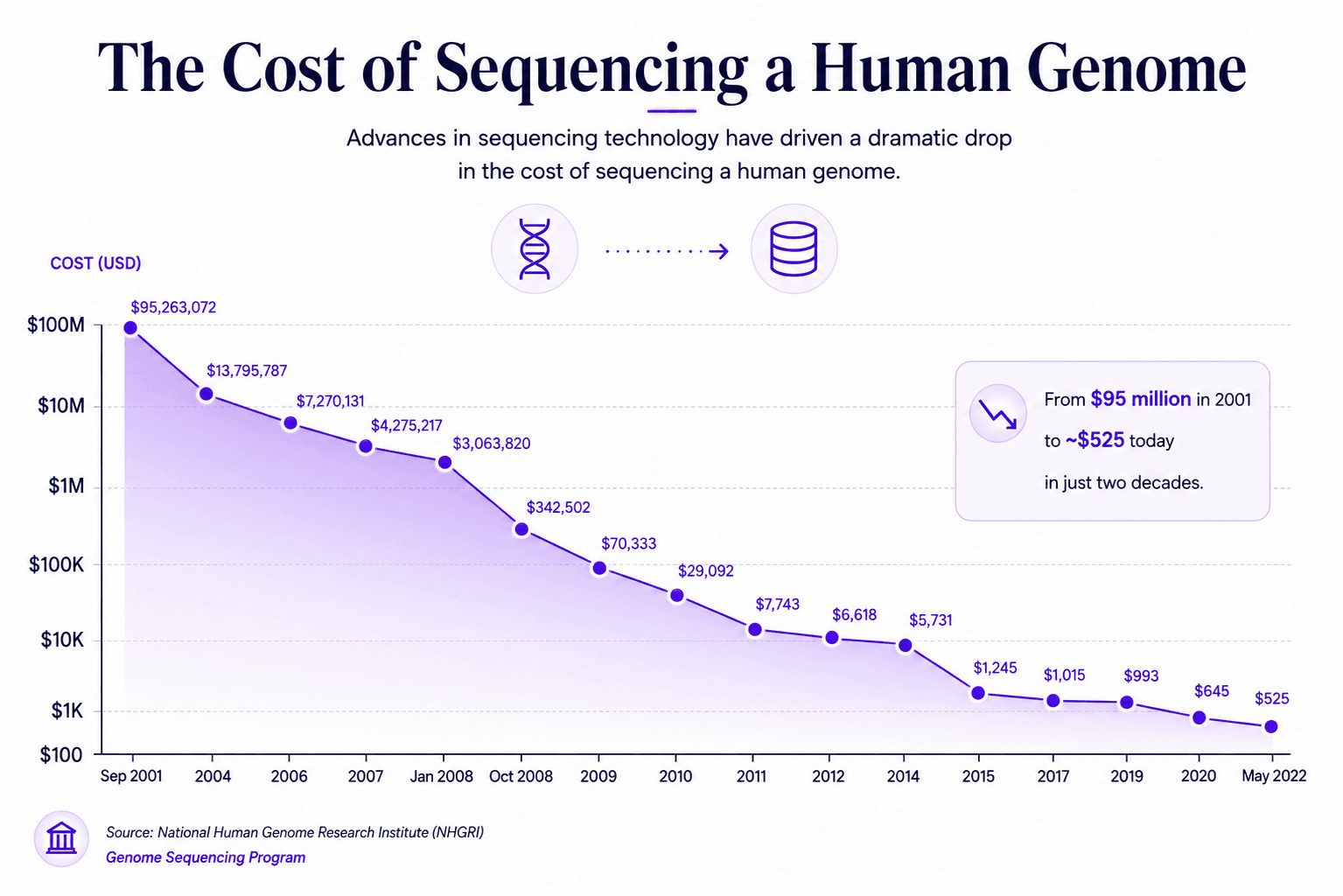
Information that had remained hidden within cells for billions of years could now be captured, stored and analysed at scale
Reading, however, is not the same as understanding.
As biological datasets expanded, researchers encountered an unexpected challenge. They could generate information far faster than they could interpret it. A single human genome contains more than three billion base pairs, while even a single cell carries thousands of interacting biological processes that continuously influence one another in ways that remain hard to predict.
The bottleneck had shifted from collecting biological data to understanding what it meant.
Humanity had learned to read the language of life at an unprecedented scale. The next challenge was learning how to interpret it.
Prediction Is the Threshold Between Science and Engineering
This is where AI entered the picture.
Much of the conversation around AI in biology focuses on automation, faster experiments, improved workflows and the ability to process vast quantities of biological data. Those developments matter.
Its greater contribution, however, is prediction.
AlphaFold is often described as a breakthrough in protein structure prediction. While accurate, that description captures only part of its significance.
Determining the three-dimensional structure of a protein required specialised equipment, considerable resources and, in many cases, years of experimental work. Researchers pursued answers patiently because there was often no alternative.
AlphaFold demonstrated that aspects of biological complexity could be modelled with remarkable accuracy. More importantly, it showed what prediction itself could mean for biology.
Historically, biology relied on experimentation because reliable prediction simply wasn't possible.
AI systems such as AlphaFold are beginning to change that. They allow researchers to model aspects of living systems before stepping into the laboratory, moving part of the discovery process into computation.
The pattern is familiar across engineering. Aircraft are simulated before they fly. Microprocessors are modelled before they are manufactured. Prediction reduces uncertainty, allowing better designs to emerge before anything is physically built.
Living systems have long resisted that approach because they are adaptive, interconnected and extraordinarily complex. Advances such as AlphaFold suggest that some aspects of biology can now be represented computationally with a precision that would have seemed implausible a decade ago.
 Modelling a system opens it to exploration, and exploration opens the door to design. That is the threshold biology is beginning to cross, from a science centred on discovery toward one that increasingly resembles engineering.
Evolution Is No Longer Biology's Only Search Engine
The significance of this shift becomes even clearer through the lens of generative biology. Prediction changes how researchers understand living systems. Generation changes how they explore them.
For nearly four billion years, evolution was the only mechanism capable of exploring biological possibility. Nature generated variation, selection acted upon it, and useful outcomes survived. Every protein, metabolic pathway and biological function that exists today emerged through this extraordinarily long and often inefficient process.
The living world is a record of that search.
Biological innovation continued to follow the same logic. Scientists searched for solutions that already existed somewhere in nature.
Today, AI models trained on biological sequences are expanding that search. Rather than limiting exploration to what evolution has already produced, researchers can investigate entirely new regions of biological possibility before stepping into the laboratory.
One of the clearest examples is ESM3, an AI model designed to understand and generate biological sequences. Researchers used it to create a fluorescent protein called esmGFP that differs substantially from naturally occurring fluorescent proteins while retaining its biological function.
The significance lies not in creating a new protein. Biologists have engineered proteins for decades. What is changing is where exploration begins.
Researchers can now explore biological design space computationally before validating the most promising candidates experimentally. The search itself is becoming programmable.
For most of scientific history, discovery meant finding solutions that already existed somewhere in nature.
Now it may also involve creating solutions that never existed at all.
That possibility does not diminish the wonder of biology. If anything, it expands it.
The biological world we know may represent only a fraction of what is biologically possible.
The Laboratory in the Age of Prediction
As biology changes, so does the laboratory.
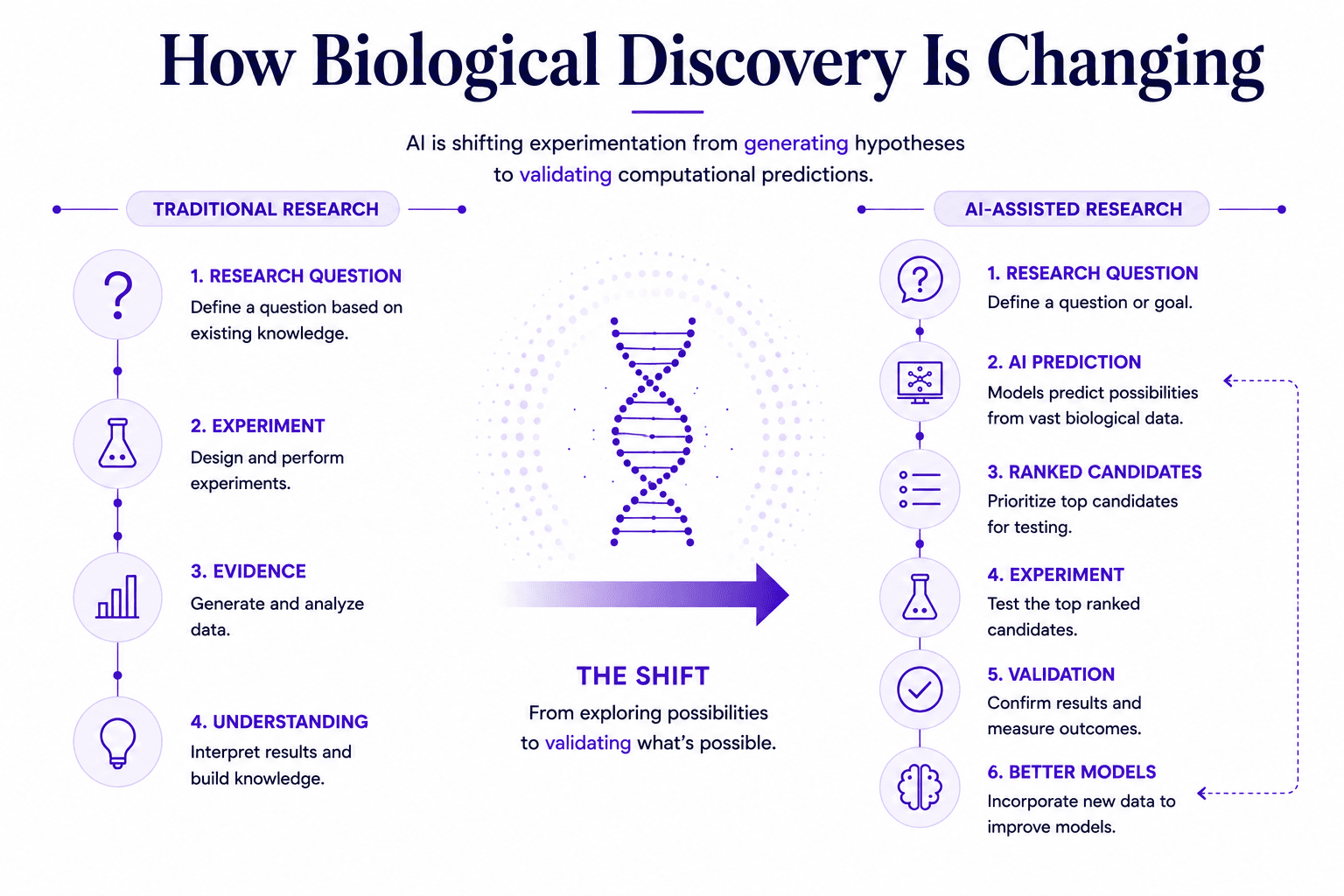
The traditional rhythm of biological discovery was familiar. Researchers generated hypotheses, designed experiments, waited for results and refined their understanding accordingly. Progress was often slow, painstaking and inseparable from the realities of physical experimentation.
Today, AI, robotics and laboratory automation are compressing that cycle. Predictive models generate promising hypotheses, automated systems test them at scale, and experimental results feed back into the models, creating a continuous learning loop.
Discovery becomes more iterative, allowing researchers to evaluate many more possibilities before deciding which deserve deeper investigation.
 This shift is not about replacing scientists. It is about changing where their expertise creates the most value. As routine experimentation becomes increasingly automated, researchers can spend more time framing the right questions, interpreting results and making scientific decisions that machines cannot.
This ambition is reflected in autonomous laboratories and initiatives such as Chan Zuckerberg Biohub's Virtual Cell programme, which explores AI models capable of simulating aspects of cellular behaviour before experiments are performed. Biology remains too complex to predict completely, but even partial simulation can make experimentation faster and more targeted.
The laboratory remains indispensable, but its role is evolving from generating ideas to validating the most promising ones.
What Programmable Biology Actually Means
The phrase programmable biology does not suggest that living systems can be controlled with the precision of software. Biology remains dynamic, adaptive and deeply influenced by context. What has changed is not biology itself, but our ability to understand, predict and influence aspects of it.
Historically, biology was primarily a science of observation. Programmable biology describes its gradual transition toward modelling, influencing and increasingly designing biological systems to achieve specific outcomes.
The transition is already visible. Gene-editing technologies such as CRISPR allow precise changes to genetic instructions. Engineered cells can perform increasingly sophisticated tasks, while advanced cellular therapies integrate multiple biological signals before producing a response. Different technologies, but a shared direction.
The goal is no longer only to understand biological behaviour.
It is to shape it.
From Molecules to Industries
Every major technological revolution eventually extends beyond the field that created it. Biology may be approaching a similar inflection point.
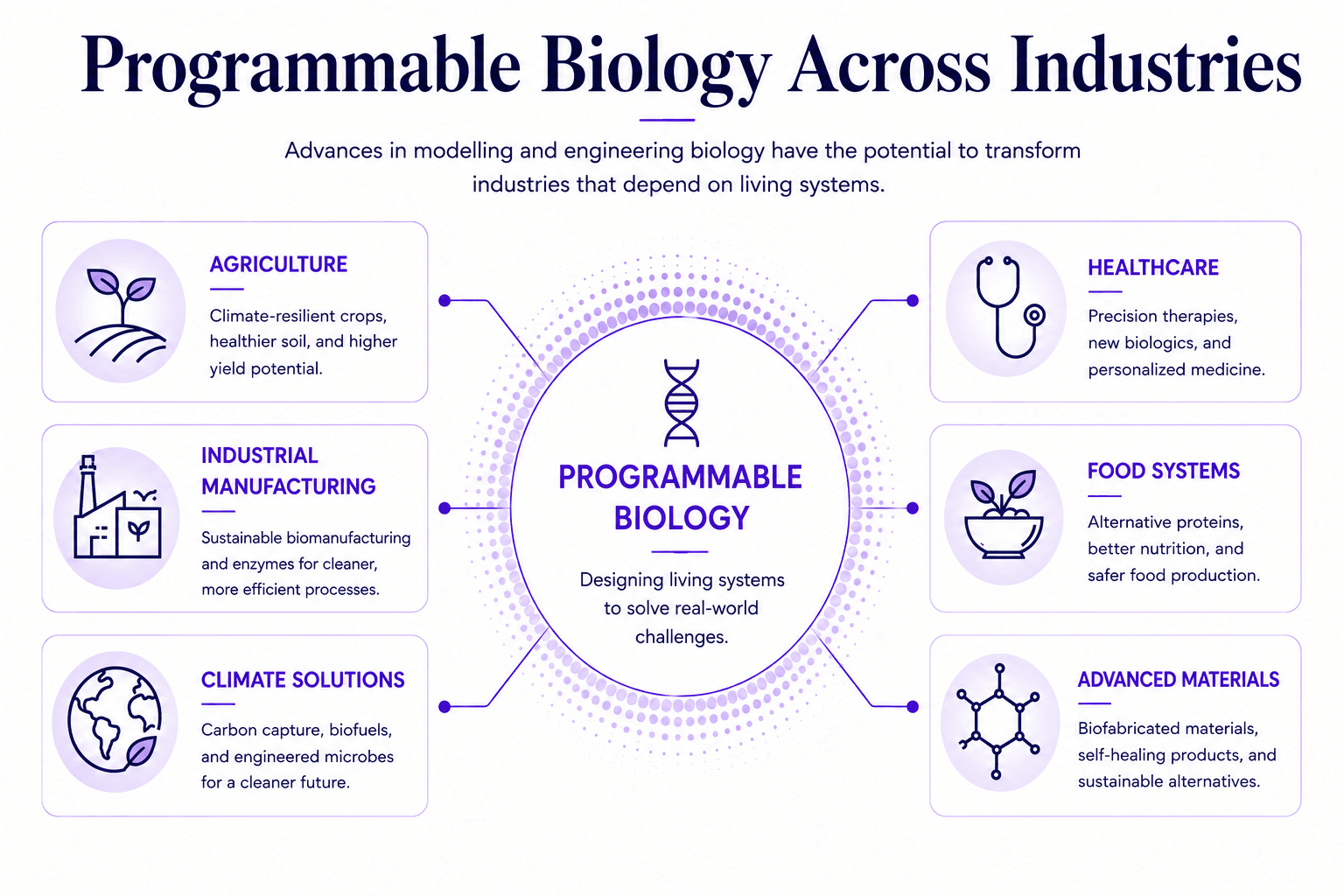 As our ability to model and engineer biological systems improves, the implications extend far beyond healthcare. The industries highlighted above represent some of the earliest areas where programmable biology is beginning to reshape how products are developed, materials are produced and biological processes are harnessed.
These developments point to biology emerging as a new design medium. Just as software reshaped industries beyond computing, programmable biology may influence fields that have never traditionally been viewed as part of biotechnology, even if living systems remain far more complex and less predictable than software.
History offers a familiar lesson. When a previously inaccessible domain becomes programmable, innovation accelerates in ways that are difficult to foresee.
Biology Is Becoming a Design Discipline
Most discussions about programmable biology focus on breakthroughs such as AlphaFold, CRISPR, biological foundation models and autonomous laboratories. Each is important.
The deeper transformation is not any single breakthrough, but the gradual shift from studying biology to intentionally designing aspects of it. Living systems remain extraordinarily complex, yet even partial predictability changes what is possible. Researchers can increasingly explore biological possibilities computationally before validating them experimentally.
The result is the emergence of biology as a new design medium, enabling researchers and engineers to shape living systems with growing precision.
Biology has largely been something humanity sought to understand.
Gradually, it is becoming something humanity can begin to design.
We are moving from reading biology to writing it.
References
-
International Human Genome Sequencing Consortium.
Initial sequencing and analysis of the human genome.
Nature, 2001.
https://www.nature.com/articles/35057062 -
Jumper, J. et al.
Highly accurate protein structure prediction with AlphaFold.
Nature, 2021.
https://www.nature.com/articles/s41586-021-03819-2 -
Hayes, T. et al.
Simulating 500 million years of evolution with a language model (ESM3).
Science, 2025.
https://www.science.org/doi/10.1126/science.ads0018 -
Doudna, J. A., & Charpentier, E.
The new frontier of genome engineering with CRISPR-Cas9.
Science, 2014.
https://www.science.org/doi/10.1126/science.1258096 -
Chan Zuckerberg Biohub.
Virtual Cell Initiative.
https://www.czbiohub.org/