The Physics & Trust Challenge: Why Aerospace Engineering Demands a New Approach to Design Space Exploration
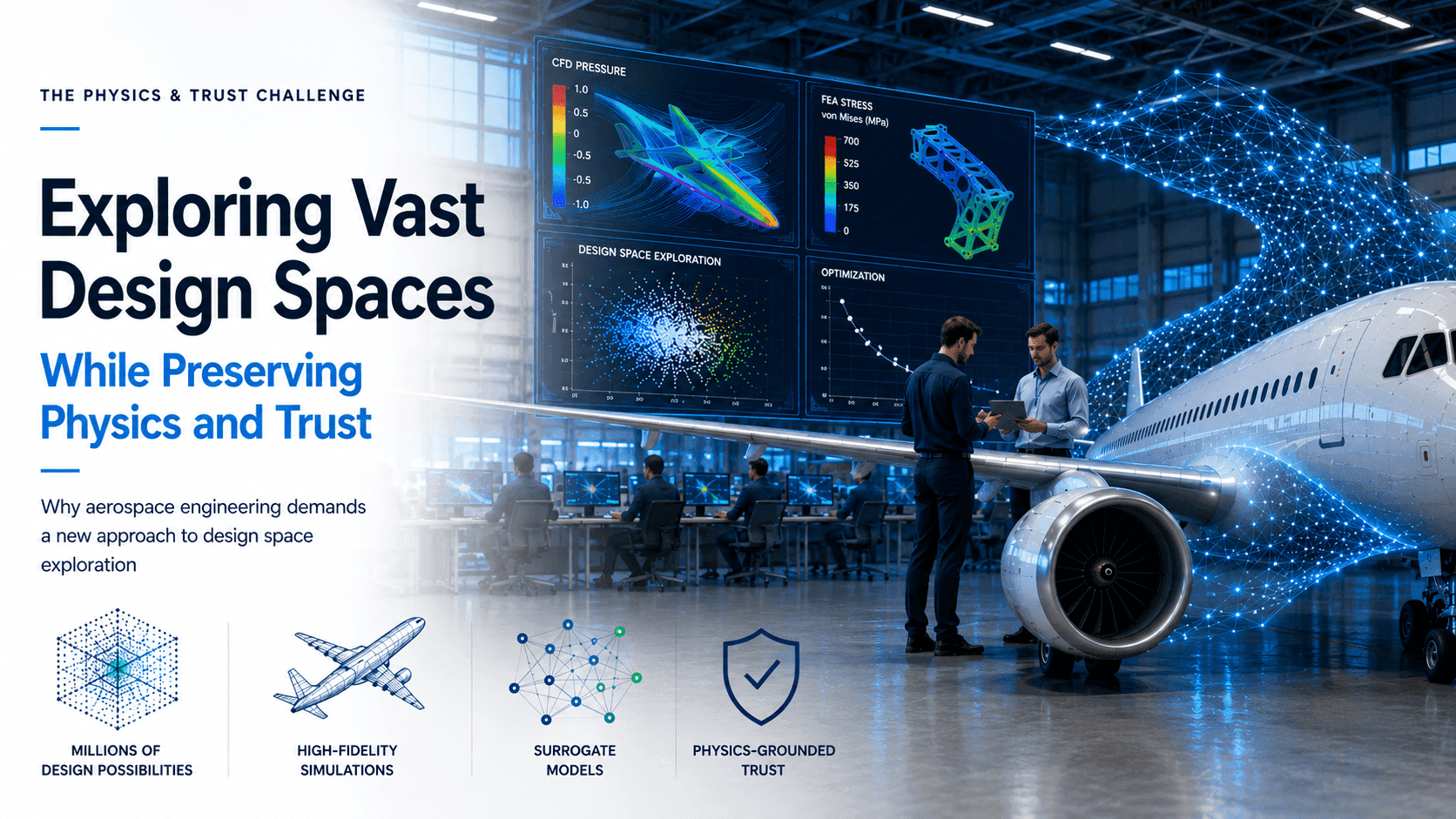
The honest engineering problem is not that aerospace companies cannot simulate aircraft. They absolutely can.
Aerospace companies already operate some of the most advanced simulation environments in the world. Structural FEA, CFD, aeroelastic analysis, fatigue analysis, multiphysics modelling, certification testing, and probabilistic reliability analysis are already deeply embedded into their workflows. The problem is that these simulations are incredibly expensive in terms of engineering time and computational cost.
A single high-fidelity structural or aero-structural simulation may take hours or even days depending on mesh size, nonlinearities, contact conditions, turbulence modelling, load combinations, and solver convergence. Aerospace structures are especially difficult because they are lightweight, highly optimized, and safety critical. Even a small geometric change in a wing rib, pylon fitting, fuselage frame, or compressor blade can alter stress distributions, fatigue life, vibration modes, or buckling behavior in non-intuitive ways.
The Design Space Problem
Now combine that with what modern aircraft programs actually look like. No aircraft is ever designed just once. Engineers continuously explore:
- New material combinations
- Lightweighting opportunities
- Geometry modifications
- Different load envelopes
- Fatigue scenarios
- Manufacturing constraints
- Supplier-driven redesigns
- Operational conditions
- Certification margins
This process is called Design Space Exploration (DSE). The problem is that the number of combinations grows exponentially. Aerospace literature repeatedly calls this the "curse of dimensionality." Engineers may want to test thousands of parameter combinations, but realistically they can only afford to run a limited number of high-fidelity simulations.
That creates a real engineering bottleneck.
What Happens in Practice
Engineers usually run a smaller subset of expensive FEA and CFD simulations. They build engineering intuition around them, add conservative safety margins because they cannot fully explore the design space, and avoid risky configurations because simulation coverage is limited. When geometry or operating assumptions change, large batches of simulations often need to be rerun entirely.
This is safe, but slow and expensive.
The Trade-Off Between Optimization and Safety
In aerospace, that matters enormously. Programs operate under strict certification requirements, multi-decade fatigue expectations, aggressive weight targets, and massive economic pressure.
A few kilograms of unnecessary structural weight multiplied across thousands of aircraft becomes a huge fuel cost over decades. On the other hand, underestimating fatigue or stress concentrations is unacceptable because structural failure risk is catastrophic. That tension between aggressive optimization and absolute safety is exactly why aerospace simulation is so computationally intense.
Where Surrogate Models Fit
A surrogate model is essentially a fast mathematical approximation of a high-fidelity simulation. Instead of solving the full physics equations every time from scratch, the surrogate learns the relationship between geometry, loads, materials, mission profiles, and resulting engineering behavior.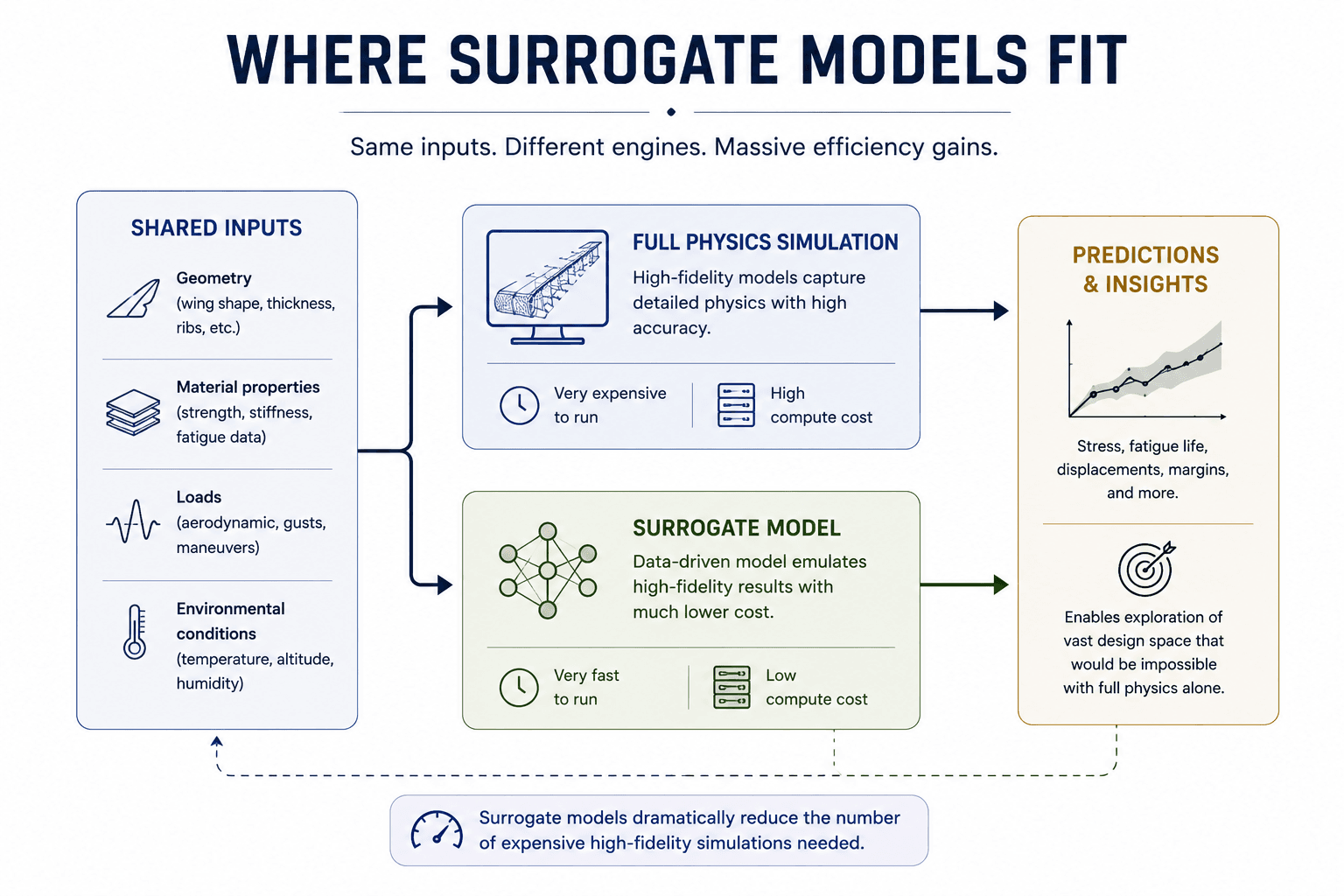
The goal is not to replace physics solvers entirely. The goal is to dramatically reduce the number of expensive simulations engineers must run.
This idea already exists academically and industrially. Aerospace researchers use surrogate models for compressor blade stress prediction, airfoil optimization, wing structural optimization, fatigue estimation, uncertainty analysis, and design-space exploration.
What Still Needs to Be Solved
Most existing surrogates fail in one of three ways.
1. They Struggle Beyond Trained Conditions
If the model only saw 100 landing-cycle scenarios, can it reliably estimate behavior at 200 cycles? That extrapolation problem is extremely difficult.
2. They Lack Trustworthy Uncertainty Quantification
Engineers need to know how confident a prediction is. They need to know whether it is physically admissible and whether they are operating outside the model's valid regime. A fast answer without calibrated uncertainty is not useful in certification-heavy industries.
3. They Do Not Integrate Operational Telemetry Cleanly
Aircraft generate enormous operational data including vibration, strain, thermal behavior, load histories, landing profiles, and engine harmonics. Most simulation workflows still do not fully close the loop between in-service operational behavior and future design iterations.
The Problem Worth Solving
This is a real opportunity.
The strongest problem statement is therefore not "We built an AI platform for aerospace." Nor "We built predictive maintenance." Nor "We visualize aircraft data."
The real engineering problem is:
"How do we let aerospace engineers explore vastly larger design and operational spaces, predict future structural behavior beyond directly simulated regimes, and obtain near-real-time engineering feedback while still preserving physics fidelity, uncertainty awareness, and engineering trust?"
That is a real aerospace engineering problem. That is technically credible. That aligns with how aerospace simulation teams actually think. And that is exactly why a hybrid modelling framework matters.